
Your cart is currently empty!.
You may check out all the available products and buy some in the shop.
Continue Shopping
15 in stock
15 in stock
₹2,380.95
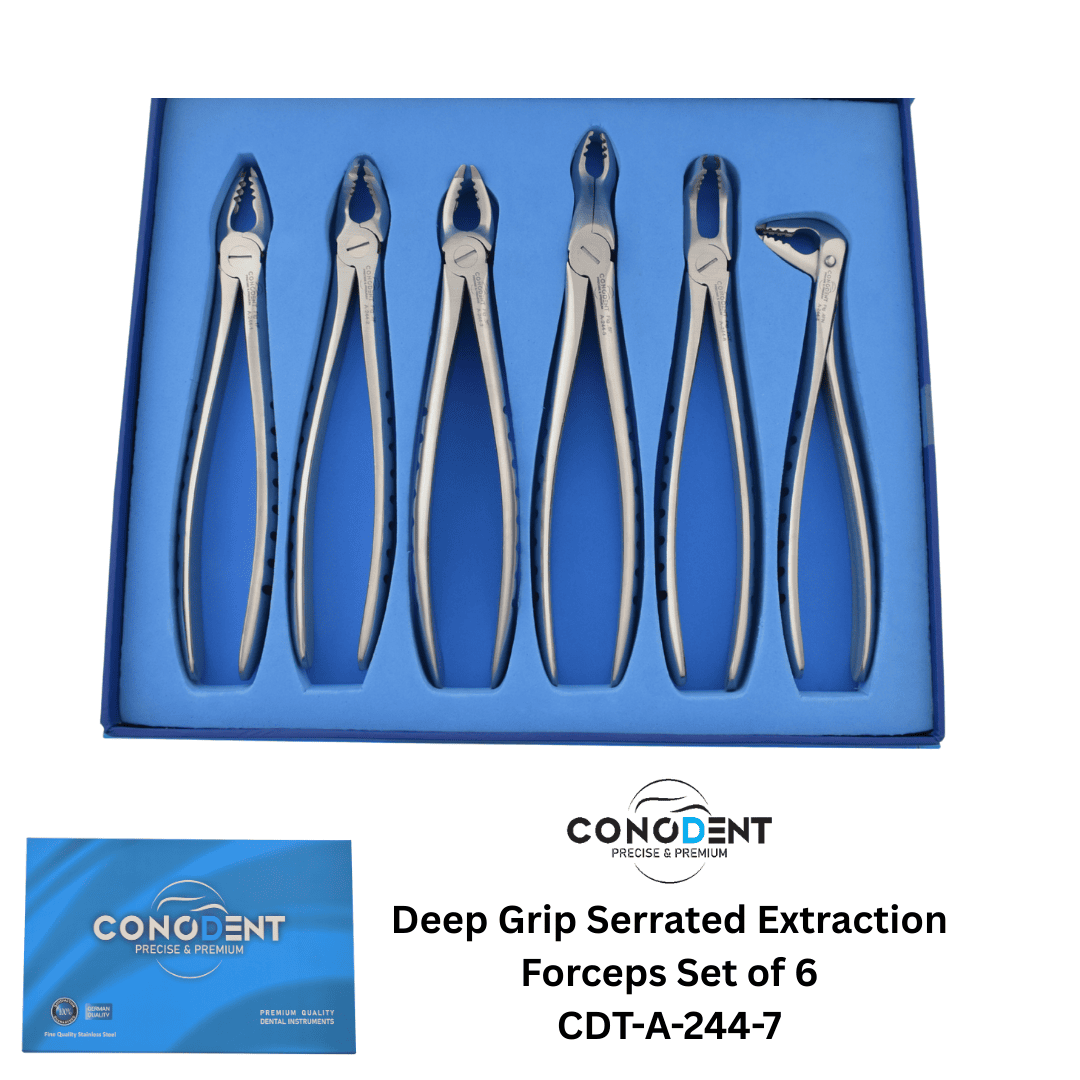
The Conodent Deep Grip Atraumatic Extraction Forceps #25 (CDT-A-244-25) is a premium dental extraction instrument designed for the precise and minimally traumatic extraction of teeth using the #25 beak configuration. Featuring Conodent's Deep Grip technology and an ergonomic anatomical handle, it provides a secure grip, superior control, and efficient force transmission while preserving the surrounding alveolar bone and soft tissues. Manufactured from medical-grade surgical stainless steel, the forceps are corrosion-resistant, fully autoclavable, and ideal for general dentistry, oral surgery, and atraumatic extraction procedures.
The CONODENT CDT-A-244-25 is a dedicated surgical instrument configuration within the premium Deep Grip Anatomical Series. Within CONODENT’s specialized catalog, the specific “-25” numerical suffix designates the Mandibular Root & Premolar Pattern (clinically referred to as the lower universal root/bicuspid forceps).
Engineered with a severe right-angle hinge architecture paired with parallel, narrow-profile beaks, this model is specifically optimized for extracting single-rooted lower premolars, lower anterior roots, and severely fractured mandibular root fragments buried deep within the alveolar bone housing.
The structural profile of the CDT-A-244-25 features a precise right-angle beak orientation relative to the handle shank.
Neutral Wrist Ergonomics: This 90-degree configuration allows the oral surgeon to maintain a completely natural, unstrained wrist posture while navigating the mandibular arch, preventing long-term wrist fatigue.
Direct Vertical Leverage: The right-angle hinge ensures that axial forces applied by the clinician translate directly down the vertical long axis of the mandibular root system, maximizing mechanical efficiency.
Mandibular roots and premolars often feature narrow mesiodistal profiles that are easily crushed or damaged by standard, wide-beaked forceps.
Subgingival Tracking: The beaks feature a slender, ultra-thin parallel profile that slides smoothly past the marginal gingiva and deep into the tight periodontal ligament (PDL) space.
Fractured Root Recovery: By closing completely down to a near-zero gap at the tips, these parallel beaks can securely clamp onto completely submerged root fragments, eliminating the need for aggressive bone removal.
Micro-Interlocking Traction: The internal faces of both beaks are chemically and mechanically detailed with fine, multi-directional laser micro-serrations. These microscopic ridges bite directly into dense radicular dentin.
Anti-Slip Stability: This precise grip prevents the instrument from rotating or slipping off smooth, conical root structures during heavy luxation, ensuring safe energy transfer and avoiding collateral tissue lacerations.
Uniform Load Distribution: The highly contoured, hand-conforming handle design spreads physical mechanical load evenly across the clinician’s palm and fingers.
Pinch Force Mitigation: By maximizing surface area contact, this design significantly lowers the physical gripping pressure required to maintain a secure hold, keeping hand fatigue minimal during stubborn extractions.
Forged in the Sultanate of Oman from clinical-grade, high-density stainless steel.
Non-Reflective Satin Finish: The surface features a fine matte/satin treatment that diffuses high-intensity light from dental operatory lamps and surgical microscopes, eliminating blinding glare.
Corrosion Resistance: The specialized chromium-rich alloy provides robust protection against chemical pitting, staining, and thermal breakdown over thousands of autoclave cycles.
| Parameter | Detailed Technical Specifications |
| Product Brand | CONODENT |
| Product SKU / Catalog Code | CDT-A-244-25 |
| Series Classification | Deep Grip Anatomical Series |
| Pattern Designation | Mandibular Root & Premolar Pattern (#25 Suffix) |
| Joint Alignment | 90° Mandibular Right-Angle Orientation |
| Beak Geometry | Symmetrical, Narrow, Ultra-Thin Parallel Deep-Grip Taper |
| Grip Architecture | Internal Laser-Cut Multi-Directional Micro-Serrations |
| Handle Configuration | Asymmetric Ergonomic Anatomical Profile |
| Material Composition | Medical-Grade, High-Density, Corrosion-Resistant Stainless Steel |
| Surface Finish | Non-Reflective Satin Finish |
| Sterilization Compatibility | 100% Autoclavable / Validated up to 134°C (273°F) |
| Country of Manufacture | Sultanate of Oman |
Sulcular Disruption: Sever the epithelial attachment completely using a periotome or sharp sulcular knife to clear a pathway for the beaks.
Axial Seating: Align the right-angle beaks parallel to the long axis of the lower root or premolar. Gently slide the ultra-thin tips apically into the PDL space.
Deep Purchase: Drive the tips apically until the micro-serrations grasp solid radicular structure beneath any coronal decay or fracture lines.
Controlled Luxation: Mandibular premolars possess largely straight, single-rooted geometries but are encased in dense cortical bone. Utilize the handle leverage to apply controlled, slow mesio-distal rotation paired with minor bucco-lingual rocking forces. Rely on the micro-serrations to hold continuous traction until the root releases cleanly from the bone housing.
CRITICAL MAINTENANCE NOTE: Because the right-angle joint of mandibular forceps undergoes significant torsional stress, keeping the hinge clear of mineral buildup is vital. Following automated ultrasonic cleaning in a neutral pH enzymatic solution, always apply a professional-grade, water-soluble dental instrument lubricant (milking agent) directly into the hinge assembly prior to autoclaving. Work the joint several times to distribute the lubricant. Autoclave the instrument inside a sterilization pouch in an open, unlocked position using a standard vacuum cycle up to 134°C (273°F). Run a complete dry cycle to eliminate any risk of localized micro-corrosion.
Only logged in customers who have purchased this product may leave a review.