
Your cart is currently empty!.
You may check out all the available products and buy some in the shop.
Continue Shopping
15 in stock
15 in stock
Original price was: ₹4,500.00.₹2,500.00Current price is: ₹2,500.00.
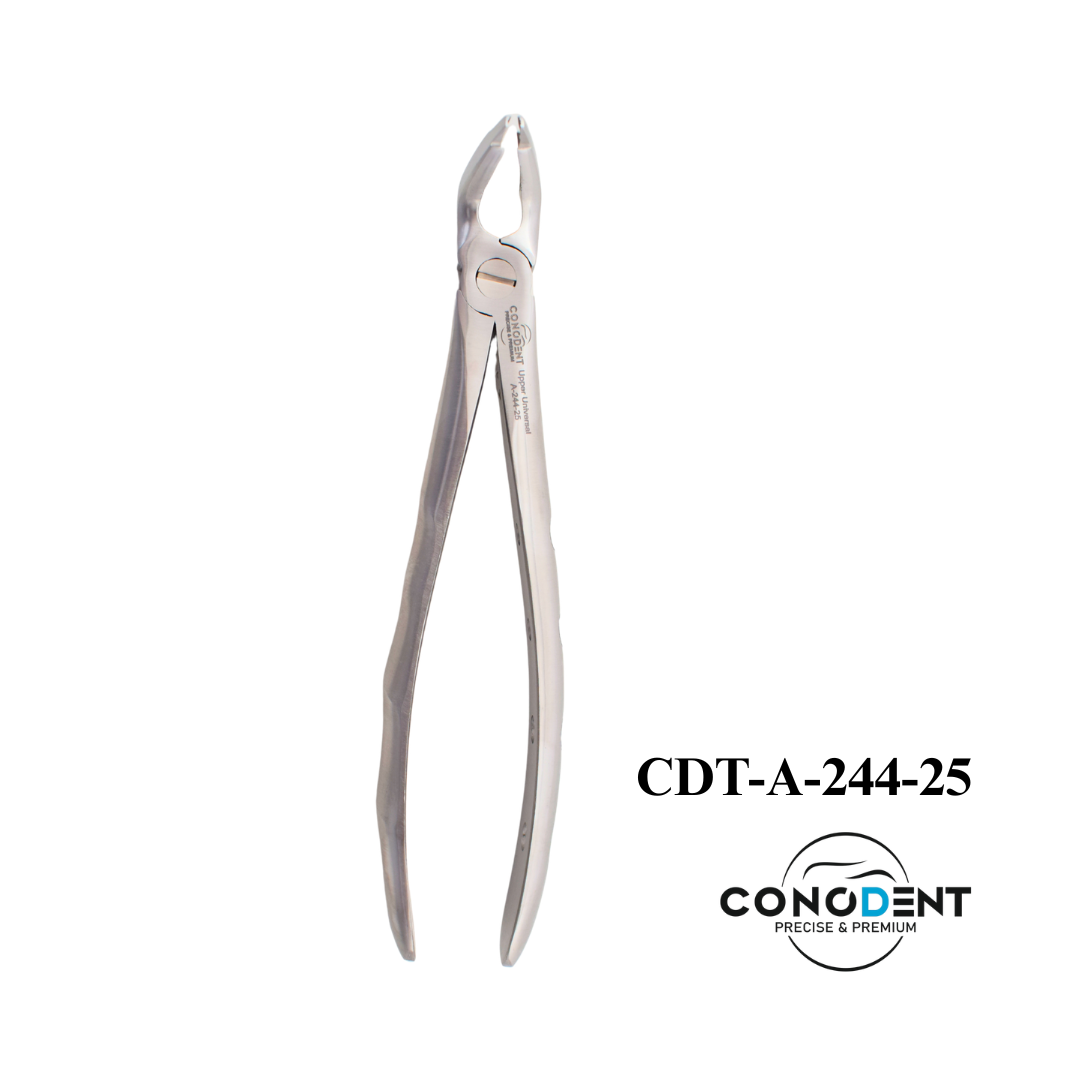
The Conodent Deep Grip Anatomical Handle Extraction Forceps (CDT-A-244) is a premium dental extraction instrument engineered to provide superior grip, enhanced control, and reduced hand fatigue during tooth extractions. Featuring an ergonomic anatomical handle with a deep-grip design, it ensures excellent comfort, stability, and force transmission for precise, atraumatic extraction procedures. Manufactured from medical-grade surgical stainless steel, the forceps are corrosion-resistant, fully autoclavable, and ideal for use in dental clinics, oral surgery, and general practice.
The CONODENT Deep Grip Anatomical Forceps (Special Pattern, SKU: CDT-A-244-24) represents the pinnacle of modern exodontia instrument engineering. Developed specifically to bridge the gap between traditional extraction techniques and minimally invasive, bone-preserving surgical protocols, this specialized instrument is designed for clinicians who refuse to compromise on ergonomics, tactile feedback, and structural durability.
Manufactured under stringent quality control protocols in the Sultanate of Oman, CONODENT combines advanced clinical metallurgy with state-of-the-art anatomical design to deliver a premium surgical tool that excels in high-stakes, structurally compromised extraction scenarios.
Traditional flat-handled extraction forceps concentrate mechanical forces into isolated pinch points across the clinician’s palm and fingers, leading to rapid hand fatigue and a heightened risk of carpal tunnel strain over long clinical days. The CDT-A-244-24 features a highly contoured, asymmetric ergonomic anatomical handle.
Load Equalization: The handle configuration is explicitly shaped to match the natural resting geometry of a clenched human fist. By maximizing the surface area contact between the instrument and the clinician’s hand, the mechanical load is distributed uniformly across the entire palmar surface and digits.
Force Amplification: This optimized contact area drastically lowers the physical pinch force required to maintain an unyielding hold on the tooth, allowing the clinician to focus energy on controlled luxation rather than maintaining a death-grip on the instrument.
The defining characteristic of this “Special Pattern” variant is its unique beak-to-hinge offset geometry. Standard linear extraction forceps often suffer from physical clearance limitations when encountering misaligned, crowded, or severely broken-down dentition.
Optimized Approach Vector: The modified structural curvature of the CDT-A-244-24 provides an altered path of insertion. This enables the clinician to maintain a vertical approach parallel to the long axis of the tooth without striking the opposing dental arch or interfering with adjacent healthy teeth.
Subgingival Access: This specialized geometry is particularly invaluable when targeting roots that have fractured completely below the crestal bone margin, allowing for deep apical seating without sacrificing structural visibility.
Preserving the surrounding alveolar bone and minimizing trauma to the soft tissue architecture is paramount for successful immediate implant placement and rapid post-operative healing.
PDL Glide Path: The working tips of the CDT-A-244-24 are engineered with a thin, precision-tapered profile that allows them to glide seamlessly down into the tight periodontal ligament (PDL) space.
Root Axis Engagement: Rather than clamping onto the brittle, decay-weakened clinical crown, these thin beaks track apically to establish a deep, solid purchase on sound root structure. This deep-grip engagement shifts the center of mass lower, dramatically minimizing the risk of fracturing the crown remnants and transforming a routine procedure into a complex surgical root recovery.
Rotational slippage during intense luxation forces is a leading cause of root fracture and accidental soft-tissue lacerations. To eliminate this clinical variable, the internal gripping faces of the CDT-A-244-24 beaks are detailed with micro-interlocking laser-cut serrations.
Multi-Point Mechanical Traction: These fine, multi-directional grooved channels bite into the dense radicular dentin at a microscopic level.
Rotational Stability: The resulting micro-lock eliminates all lateral and rotational play between the instrument and the root surface. Consequently, every ounce of force applied to the handle is translated directly and efficiently into tearing the PDL fibers, rather than slipping uselessly across the enamel surface.
Forged from premium, clinical-grade high-density stainless steel, the CDT-A-244-24 is engineered to withstand severe torsional stress without bowing or losing its strict calibration.
Anti-Glare Satin Finish: The entire instrument is treated with a specialized, non-reflective matte/satin finish. Under high-intensity dental operatory lights or surgical microscopes, traditional polished instruments create blinding hot-spot reflections that induce eye strain and obscure fine surgical margins. The satin finish diffuses this light completely, ensuring pristine visual tracking at all times.
Corrosion Resistance: The specialized alloy chemistry offers exceptional resistance against pitting, discoloration, and structural degradation when exposed repeatedly to aggressive chemical cleaning agents and high-temperature sterilization.
| Parameter | Detailed Technical Specifications |
| Product Brand | CONODENT |
| Product SKU / Catalog Code | CDT-A-244-24 |
| Series Classification | Deep Grip Anatomical Series |
| Pattern Designation | Special Pattern #24 (Modified Structural Angulation) |
| Handle Configuration | Asymmetric Ergonomic Anatomical Profile (Hand-Conforming) |
| Beak Geometry | Ultra-Thin, Precision-Tapered, Atraumatic Profile |
| Grip Enhancements | Internal Laser-Cut Multi-Directional Micro-Serrations |
| Material Composition | Medical-Grade, High-Density, Corrosion-Resistant Stainless Steel |
| Surface Finish | Non-Reflective Matte / Satin Protective Finish |
| Sterilization Compatibility | 100% Autoclavable / Validated up to 134°C (273°F) |
| Country of Manufacture | Sultanate of Oman |
Initial Access: Reflect the marginal gingiva away from the root using a periotome or luxator to prevent soft-tissue crushing.
Apical Seating: Align the specialized pattern beaks parallel to the long axis of the root. Gently but firmly slide the thin tips apically into the PDL space.
Establishing the Purchase: Advance the instrument until the micro-serrations engage sound radicular structure beneath the decay, fracture, or crestal bone line.
Controlled Luxation: Utilizing the enhanced leverage provided by the anatomical handle, apply slow, continuous, controlled axial rotation and minor facio-lingual luxation forces. Avoid aggressive jerking or pulling movements; let the micro-serrations hold the traction while the continuous pressure induces ischemic necrosis of the PDL fibers, easing the root smoothly from the socket.
To ensure the CDT-A-244-24 maintains its fluent articulation and failsafe grip over thousands of clinical cycles, adhere strictly to the following maintenance workflow:
Immediate Debridement: Never allow blood, saliva, or tissue debris to dry on the instrument. Rinse thoroughly with demineralized water immediately post-extraction.
Ultrasonic Cleaning: Clean the forceps in an open position within an ultrasonic bath utilizing a neutral pH enzymatic detergent. Ensure the micro-serrated beaks are fully exposed to the ultrasonic waves to dislodge microscopic debris from the laser grooves.
Inspection: Post-cleaning, inspect the laser serrations for any residual debris. Check the hinge action for micro-grittiness or structural play.
The “Milking” Protocol (Hinge Lubrication):
CRITICAL MAINTENANCE NOTE: Because the anatomical joint is machined to incredibly tight tolerances to ensure zero lateral beak deflection, it is vulnerable to binding if mineral deposits accumulate. Periodically apply a high-quality, water-soluble, anti-corrosive dental instrument lubricant (milking agent) directly to the hinge joint after cleaning and prior to autoclaving. Work the joint back and forth several times to distribute the lubricant evenly. Do not use industrial or petroleum-based oils.
Autoclaving: Place the lubricated forceps into a sterilization pouch in an open/unlocked position to allow steam to completely penetrate the bearing surfaces of the hinge. Autoclave using a standard vacuum cycle up to a maximum temperature of 134°C (273°F). Allow a comprehensive dry cycle to complete before storage to eliminate any risk of localized micro-corrosion.
Only logged in customers who have purchased this product may leave a review.