
Your cart is currently empty!.
You may check out all the available products and buy some in the shop.
Continue Shopping
15 in stock
15 in stock
Original price was: ₹4,500.00.₹3,000.00Current price is: ₹3,000.00.
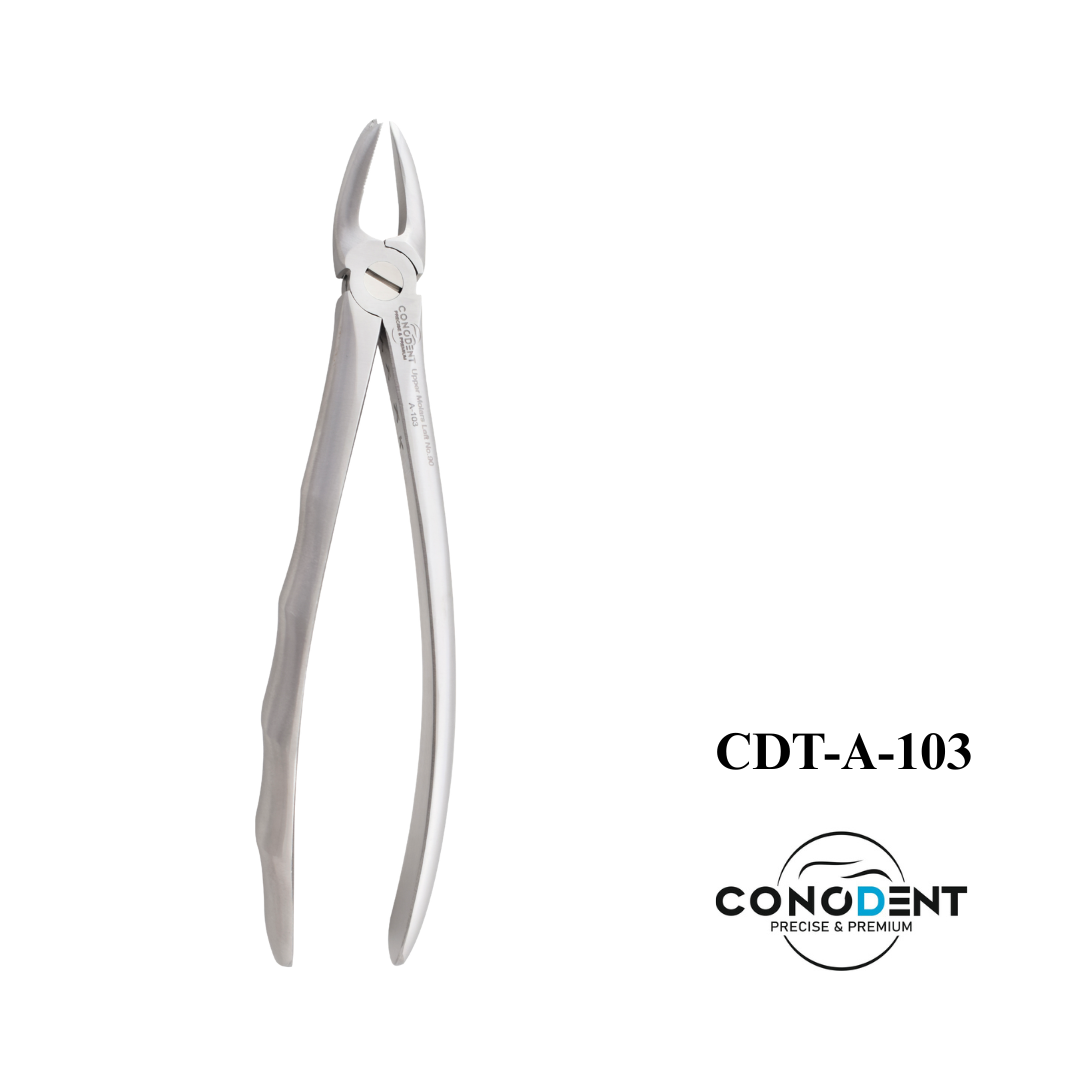
The Conodent Deep Grip Atraumatic Extraction Forceps #4 (CDT-A-244-4) is a premium dental extraction instrument designed for the precise and atraumatic extraction of upper (maxillary) incisors and canines. Its Deep Grip beak design ensures a secure hold on the tooth while minimizing trauma to the surrounding alveolar bone and soft tissues. The ergonomic anatomical handle provides superior control, enhanced leverage, and reduced hand fatigue during procedures. Manufactured from medical-grade surgical stainless steel, the forceps are corrosion-resistant, fully autoclavable, and ideal for general dentistry, oral surgery, and exodontia.
The CONODENT CDT-A-244-4 is a specialized single-instrument configuration within the premium Deep Grip Anatomical Series. While the root catalog sequence defines CONODENT’s advanced surgical extraction architecture, the individual “-4” numerical suffix designates the Maxillary Anterior Pattern.
Engineered strictly for the precise extraction of upper incisors and canines, this model features a straight hinge alignment matched to symmetrically tapered beaks. It allows clinicians to perform atraumatic exodontia while preserving the highly delicate labial bone plates characteristic of the maxillary anterior aesthetic zone.
The structural profile of the CDT-A-244-4 utilizes a completely straight beak-to-handle alignment.
Direct Vector Alignment: This linear design provides an uncompromised path of insertion along the natural vertical axis of maxillary anterior teeth.
Tactile Feedback: Because there are no offset angles or curves in the shank, rotational and apical forces are transferred without any mechanical distortion, giving the oral surgeon elite tactile feedback when sensing root anatomy variations or ligament release.
The working tips are engineered with an ultra-thin, symmetrical taper that remains parallel over a extended surface area.
Subgingival Tracking: The thin profiles slip smoothly beneath the free gingival margin and deep into the periodontal ligament (PDL) space without compressing or lacerating the fragile marginal tissue.
Radicular Adaptation: By contouring precisely to the conical root structures of upper central incisors and prominent canine roots, the beaks maximize surface contact below the cementoenamel junction (CEJ), preventing crown fracture.
The internal gripping faces of both beaks feature fine, multi-directional laser-etched serrations.
Anti-Slip Stability: Anterior teeth, particularly maxillary canines, have long, robust roots that require considerable rotational luxation to sever the dense PDL fibers. The micro-serrations interlock with radicular dentin at a microscopic level, completely eliminating the risk of sudden slippage or rotational spinning.
Cortical Preservation: Eliminating instrument slippage ensures that all applied physical energy is strictly directed into separating the tooth from the socket wall, avoiding accidental fracture of the thin labial cortical bone.
Ergonomic Load Distribution: The contoured handle architecture is designed to map perfectly against the palm and digits, widening the contact area.
Pinch-Force Reduction: This intentional geometry reduces the physical grip force required by the clinician. It lowers muscle fatigue in the hand during resistant extraction procedures while maintaining an unyielding mechanical hold.
Forged in the Sultanate of Oman from premium medical-grade high-density stainless steel.
Anti-Glare Satin Finish: The instrument undergoes an advanced surface treatment to yield a non-reflective matte/satin finish. This eliminates high-intensity reflections from bright dental operatory lights, preventing glare-induced eye strain and optimizing visualization of the subgingival margins.
Structural Longevity: The high-performance alloy formulation provides high resistance against chemical staining, pitting, and thermal stress during frequent autoclaving cycles.
| Parameter | Detailed Technical Specifications |
| Product Brand | CONODENT |
| Product SKU / Catalog Code | CDT-A-244-4 |
| Series Classification | Deep Grip Anatomical Series |
| Pattern Designation | Maxillary Anterior Pattern (#4 Suffix) |
| Joint Alignment | 180° Straight Inline Architecture |
| Beak Geometry | Symmetrical, Ultra-Thin Parallel Taper |
| Grip Architecture | Internal Laser-Cut Multi-Directional Micro-Serrations |
| Handle Configuration | Asymmetric Ergonomic Anatomical Profile |
| Material Composition | Medical-Grade, High-Density, Corrosion-Resistant Stainless Steel |
| Surface Finish | Non-Reflective Satin Finish |
| Sterilization Compatibility | 100% Autoclavable / Validated up to 134°C (273°F) |
| Country of Manufacture | Sultanate of Oman |
Tissue Reflection: Use a periotome or sharp sulcular knife to sever the epithelial attachment around the upper incisor or canine.
Axial Seating: Align the inline beaks parallel to the long axis of the root. Gently slide the ultra-thin tips apically into the PDL space along the mesial and distal root walls.
Engagement: Drive the instrument apically until a firm mechanical lock is established on solid root structure well below the cervical or decay line.
Rotational Luxation: Maxillary anterior teeth have largely conical, single-root configurations. Utilize the handle leverage to apply controlled, slow axial rotational forces (clockwise and counterclockwise). Avoid aggressive facio-palatal rocking, especially toward the thin labial bone plate, allowing the micro-serrations to steadily shear the PDL fibers until the root releases.
CRITICAL MAINTENANCE NOTE: To keep the inline joint articulating smoothly with zero lateral play, strict reprocessing discipline is required. Clean the forceps in an open position inside an ultrasonic cleaner utilizing a neutral pH enzymatic solution. Post-cleaning, always apply a high-quality, water-soluble dental instrument lubricant (milking agent) directly into the hinge assembly prior to sterilization. Work the joint back and forth to distribute the lubricant. Autoclave the instrument inside a sterilization pouch in an open/unlocked position using a standard vacuum cycle up to 134°C (273°F). Ensure a thorough dry cycle is executed to prevent micro-condensation within the joint housing.
Only logged in customers who have purchased this product may leave a review.